
Review · FRENCH POLYNESIA WHALE WATCHING TOURS
Whale Watching Tours in Bora Bora
Bora Bora’s whale watching is a real wildlife outing, not a staged aquarium show. Tohora Bora Bora takes you offshore for about three and a half hours, using a directional hydrophone to listen for humpback songs and a small boat limited to six people. If the whales are calm and conditions permit, you may enter the open sea, but swimming is never promised.
I like the small group, which gives Simon and his team room to explain what is happening and manage water entries carefully. I also like the option to stay aboard, watch the whales from the boat, and enjoy flying fish, tuna, surf, and the changing sea even if you decide not to swim.
The catch is simple: wildlife follows its own timetable. You may see several whales and spend long periods near them, or you may see none. The open-water swimming can involve waves, swell, and more than 100 meters of sustained swimming, so this suits confident swimmers far better than casual snorkelers.
Key things to know before you book
- Small boat, maximum six people: The limited group size makes the outing more personal and gives the crew more control around the whales.
- Simon leads the operation: Simon has more than 15 years of experience observing marine mammals, with Victor and Maui also named as members of the team.
- A directional hydrophone is on board: You can listen to humpback calls, not just look for blows and fins.
- Swimming requires real fitness: An entry may mean swimming more than 100 meters in open water, sometimes in waves or swell.
- No whale sighting or swim is guaranteed: Conditions, animal behavior, and maritime rules determine what happens.
- You can remain on the boat: You do not have to enter the water, and boat-based viewing can still be rewarding.
A small-boat search beyond Bora Bora’s reef
This excursion begins in Bora Bora and returns to the same meeting point. Pickup is offered, but the exact pickup arrangement should be confirmed when your booking is accepted, since confirmation is subject to availability within 48 hours.
The boat heads out for a focused search for humpback whales. Tohora Bora Bora was among the first local operators to build a public whale observation circuit, and the company’s approach is centered on patience rather than a fixed parade of sights. That matters because a whale outing has no guaranteed sequence. The captain may alter the search based on reports, sea conditions, and animal behavior.
For me, the most appealing part is the scale of the trip. With no more than six people, you avoid the feel of a large excursion boat where everyone competes for a view. A small group also makes the pre-water briefing easier to hear and follow, which is important here because the rules are strict for good reason.
Simon is the guide and captain named most often in the experience details, and the team also includes Victor and Maui. The crew’s work is not simply to locate a whale. They must judge distance, speed, sea state, and whether an animal appears comfortable with the boat. The rules on numbers, approach distances, and entries are designed to protect both people and humpbacks.
More whale watching around French Polynesia worth comparing
- Swimming with Whales in Moorea (Half Day tour)
★ 4.5 · 264 reviews - Whale Tour – Observe and swim with whales
★ 5.0 · 257 reviews - Swim with humpback whales
★ 5.0 · 224 reviews
Listening for whales with the onboard hydrophone
The directional hydrophone is one of the tour’s most distinctive features. Instead of relying only on a distant blow or a glimpse of a back, you can listen for the low, haunting calls of humpback whales beneath the surface.
This changes the rhythm of the trip. You are not just scanning the horizon in silence. The guide can use the sound to add context to what you are seeing, and the listening itself becomes part of the encounter. It also gives you something meaningful to focus on during the search, when a whale may be out of sight.
The hydrophone does not solve the main problem: whales move, and sound does not guarantee a close approach. Still, it gives the outing a stronger educational side than a simple boat ride. Simon’s long experience with marine mammals is useful here, particularly for explaining behavior and why an entry may or may not be suitable.
Keep your expectations practical. The hydrophone is a tool for listening, not a promise that a whale will surface beside the boat. Nature can offer a spectacular performance, a brief sighting, or no sighting at all.
What the open-water swim really involves
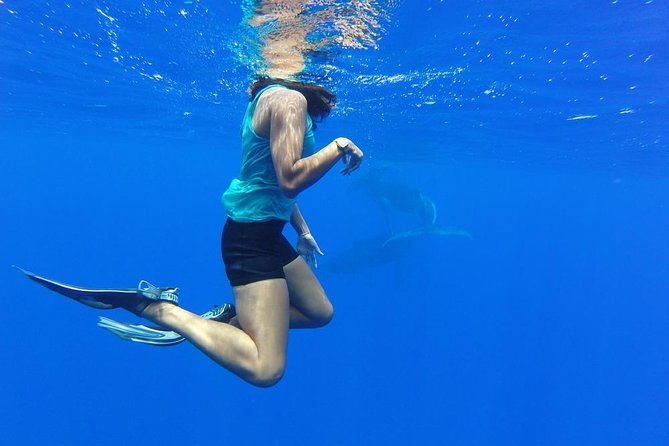
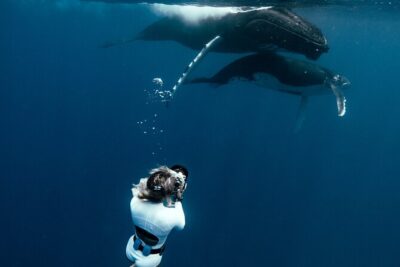
The phrase swimming with whales can sound gentle and easy. On this outing, you need to picture open ocean, not a calm lagoon. The description warns that swimming may take you more than 100 meters from the boat, and the trip can include waves or swell.
That distance is not extreme for a strong swimmer, but it is a serious demand if you are not comfortable in deep, moving water. You should be able to swim steadily, stay calm, and follow instructions without becoming a burden to the group. The company asks for a strong physical fitness level, and that is not a formality.
The crew controls the entries. Whale behavior, maritime conditions, weather, and safety all matter. Even if a whale is spotted, you may not be allowed into the water. If you do enter, the whale may move away before you reach it, or the group may need to return to the boat.
The best attitude is to treat swimming as a possible extra, not the product you are guaranteed to receive. The tour itself is whale observation by boat. An in-water encounter is a rare bonus governed by the animal and the conditions.
Why the briefing and quiet behavior matter
Before an entry, Simon gives instructions about how to approach humpback whales without disturbing them. You are expected to remain quiet in the water and follow directions closely.
That may feel strict if you have joined casual snorkeling outings where people splash, call out, and move freely. Here, noise and sudden movement can affect the animals and make the situation less safe. The crew’s insistence on rules is part of the point of a responsible wildlife outing.
You should also understand that the guide may stop you from entering, or ask you to return, if your swimming ability or conduct creates a problem. Some people find that reassuring. Others may find the firm style uncomfortable, particularly if they expected a relaxed swim with little instruction.
I would rather have clear limits than a crew that treats whales like props. Still, read the conditions honestly before booking. If you want total freedom in the water, this is the wrong kind of excursion. If you can accept a careful, controlled approach, the rules make sense.
Same sea, a different boat:
- Humpback whale watching and marine life in Moorea
★ 5.0 · 199 reviews - Private tour observing and swimming with humpback whales in Moorea
★ 5.0 · 126 reviews - Respectful whale excursion to Tahiti in 4h30
★ 4.5 · 123 reviews - Tahiti island: Whale watching Experience
★ 4.2 · 79 reviews
When the whales cooperate, the reward can be huge
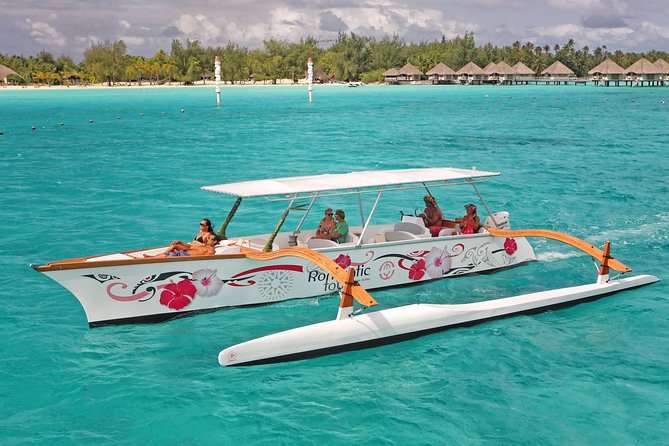
The strongest outings can be extraordinary. One described experience included several entries into the water and roughly two hours with whales. Another included a whale accompanying the boat and nearby swimmers for more than an hour, while someone who stayed aboard watched the animal’s show from a dry seat.
Those reports also show why patience matters. You may spend a long time watching one whale’s movements, waiting for the right moment, or tracking an animal that changes direction. The crew may extend the outing beyond the planned time in an effort to find whales, but that extra effort still cannot produce a result.
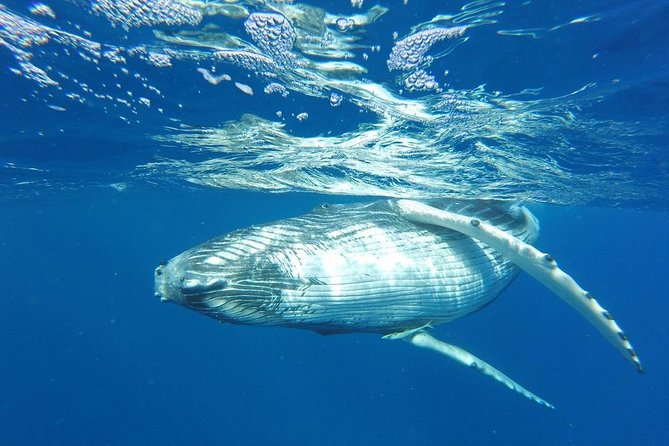
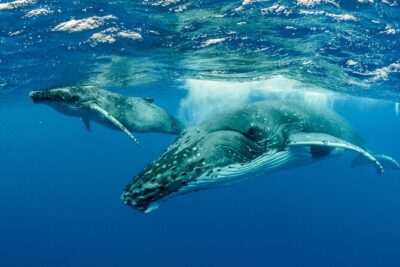
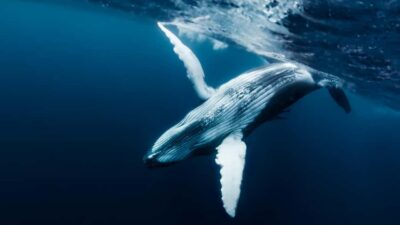
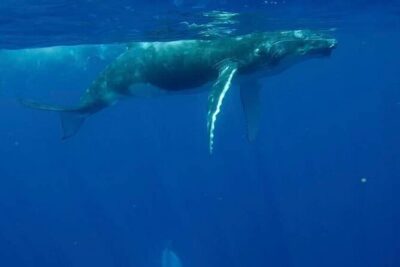
When a whale surfaces close by, the impact comes from the animal’s scale and calm movement. You might see a back roll through the water, a blow on the surface, or a whale moving near the boat and swimmers. The experience is powerful precisely because it is not choreographed.
The boat ride itself can offer smaller surprises. One outing produced flying fish, a jumping tuna, and waves breaking against the outer reef. These are not substitutes for whales, but they can turn a no-sighting day into a memorable ocean trip rather than three and a half empty hours.
The boat option is better than you may expect
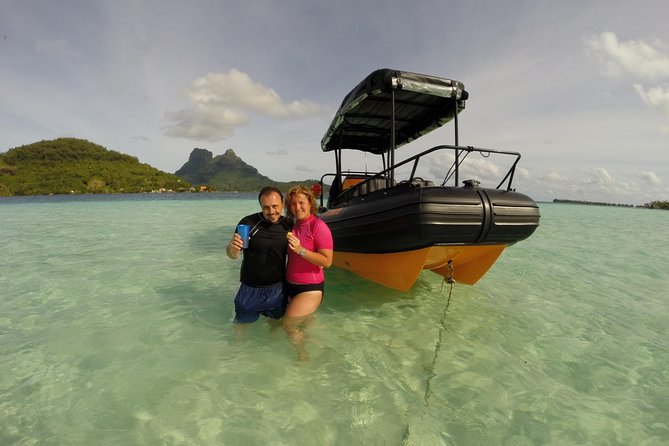
You do not have to swim. The company clearly allows you to remain aboard and observe from the boat, and this can be the best choice if the ocean is rough or you are unsure of your ability.
One participant chose not to enter because the sea was very unsettled, yet still saw a whale put on an impressive display for the boat and the swimmers. That is a useful reminder that you do not have to prove anything. Watching from the deck can be safer, more comfortable, and less stressful.
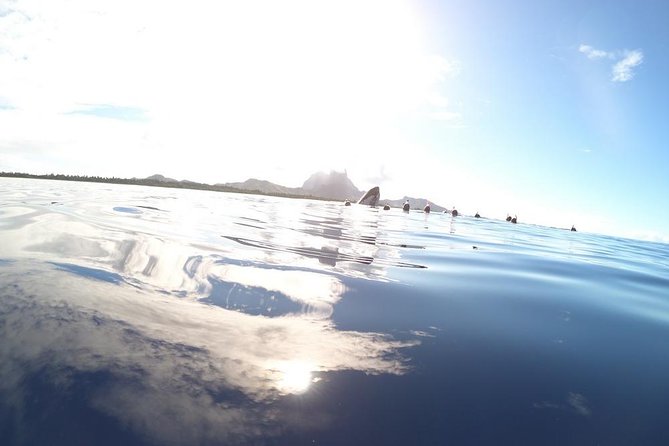
Staying aboard also lets you enjoy the broad setting. You may see the open-ocean side of Bora Bora’s reef, flying fish, tuna, and surf rolling over the reef edge. The view is different from lagoon snorkeling, with more movement and exposure to the sea.
I would tell nervous swimmers to decide in advance that boat-based viewing is a valid outcome. If you board feeling that the trip is a failure unless you enter the water, you are setting yourself up for disappointment. The crew cannot control the sea, and you should not feel pressured to swim.
Price, timing, and the real value
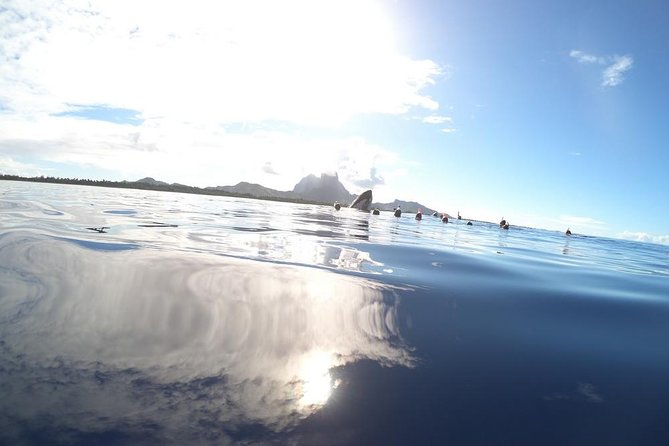
The listed price is $305.30 per person. That is a substantial amount for a three-and-a-half-hour activity, especially if you finish without seeing a whale or entering the water.
The cost is easier to understand when you consider what is involved: a specialized boat, fuel, safety equipment, a captain and guide, a small group limit, and an outing that may require extended searching. A six-person maximum also means the operator cannot spread costs across a large crowd.
Still, value depends heavily on your priorities. If you want a guaranteed attraction, this is poor value because no wildlife operator can guarantee a whale sighting. If you value a small boat, careful approach rules, a hydrophone, and a genuine chance at a rare encounter, the price may feel reasonable.
The activity receives a 4.7 rating from 250 reviews, with 92 percent recommending it. That is strong overall, but the uneven experiences are important. High marks tend to follow close whale encounters, patient searching, and a crew that helps people feel safe. Low marks often come from rough conditions, missed sightings, rescheduled departure times, or frustration with the strict swimming rules.
The practical question is not simply whether the price is high. It is whether you can pay it and remain satisfied if the result is a boat ride, an ocean show without whales, or a whale sighting from a distance.
Who should book this Bora Bora whale tour
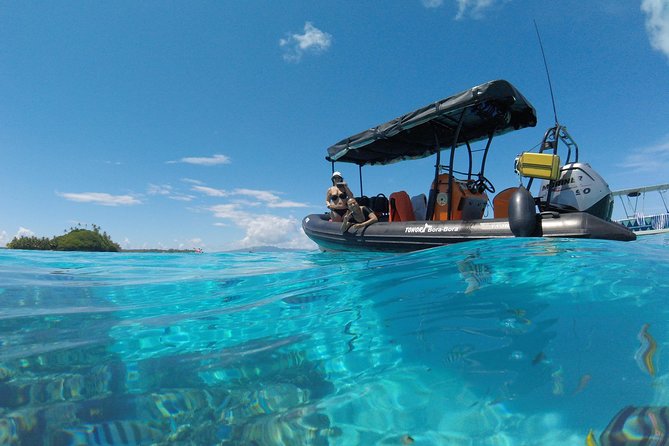
I would recommend it most strongly to:
- Confident swimmers who are comfortable in open water
- People who enjoy wildlife watching without a fixed result
- Visitors who prefer a small group over a large sightseeing boat
- Anyone interested in whale behavior and underwater sound
- Couples or families with older children who can follow strict instructions
- People willing to stay on the boat if conditions are not right
I would think twice if you are prone to seasickness, have limited swimming ability, or want calm lagoon snorkeling. The boat spends about three and a half hours in the ocean, and the sea may be rough. The company also requires a strong fitness level, so do not treat this as an easy casual excursion.
The outing is also a poor match for anyone who sees swimming as mandatory. The launch option does not ensure a swim, and a swim does not ensure contact with whales. You need to be comfortable with both possibilities.
Booking details that can affect your plans
This tour is often booked about 39 days in advance, so I would not leave it until the last moment if whale watching is a major part of your Bora Bora plans. Confirmation is sent within 48 hours, subject to availability.
The activity requires suitable weather and a minimum number of participants. If poor weather forces cancellation, you are offered another date or a full refund. If the minimum number is not met, you are offered another date, another experience, or a full refund.
Your own cancellation terms are strict. The experience is non-refundable and cannot be changed for any reason if you cancel or request an amendment. I would avoid placing it immediately before an important flight or cruise departure, since a weather change or schedule adjustment could complicate your plans.
Pickup is offered, and the activity returns to its starting meeting point in Bora Bora. Ask for the exact pickup time and location when you receive confirmation, especially if you are staying away from the main settlement.
My call: book it only if you accept the wild-card
I would book Tohora Bora Bora if I wanted a serious, small-group whale search and could accept that the ocean makes the decisions. The hydrophone, the six-person limit, Simon’s long experience, and the option to watch from the boat give the outing more substance than a quick sightseeing cruise.
I would not book it if I needed a guaranteed swim, a calm-water activity, or a fixed schedule with no chance of change. Go in ready for rough water, strict instructions, and a wildlife encounter that may be brief or may become the highlight of your stay.
The smartest way to approach this tour is to value the search itself. If you see whales, you may have an astonishing day. If you do not, the experience still depends on how much you enjoy the open sea, the hydrophone, the reef, and the honest uncertainty of meeting wild animals.
FAQ
How long does the whale watching tour last?
The outing lasts approximately 3 hours and 30 minutes and ends back at the meeting point in Bora Bora.
How many people can join the boat?
The tour has a maximum of six participants.
Is swimming with the whales guaranteed?
No. The launch option does not guarantee swimming. Entries depend on whale behavior, weather, maritime conditions, safety, and the rules protecting humpback whales.
How far might I need to swim from the boat?
The description states that swimming may take place more than 100 meters from the boat in the open sea.
Can I stay on the boat instead of swimming?
Yes. You can remain aboard and watch the whales from the boat.
Is the tour suitable for weak swimmers?
The activity requires a strong physical fitness level. Since swimming may take place in open water with waves or swell, it is intended for people who are comfortable and capable in those conditions.
What happens if bad weather cancels the tour?
If poor weather causes the tour to be canceled, you are offered a different date or a full refund. If the minimum number of participants is not met, you are offered another date, another experience, or a full refund.
New whale trips around French Polynesia
- Guided Small Group Whale Watching and Swim Tour Tahiti★ 5.0 · 57 reviews
- Respectful whale excursion to Tahiti in 4h30★ 4.5 · 123 reviews
- Whale watching on the preserved and quiet coast of Paea (Pk26)★ 5.0 · 40 reviews
- Tahiti island: Whale watching Experience★ 4.2 · 79 reviews
- Private Half Day Whale Watching Tour★ 5.0 · 18 reviews
- Private Whale Watching Adventure in Mo’orea★ 5.0 · 32 reviews
- Half Day Private Whale Watching in Moorea★ 5.0 · 10 reviews
- Humpback whale watching and marine life in Moorea★ 5.0 · 199 reviews
French Polynesia Whale Watching Tours, compared.
Swimming with Whales in Moorea (Half Day tour)
Read our review →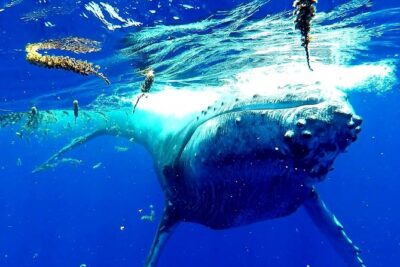
Humpback whale watching and marine life in Moorea
Read our review →
Private tour observing and swimming with humpback whales in Moorea
Read our review →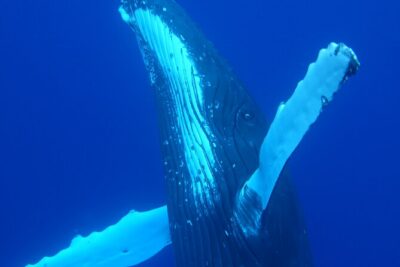
Guided Small Group Whale Watching and Swim Tour Tahiti
Read our review →Browse the lists this tour appears in