Review · CATAMARAN WHALE WATCHING
Whale & Dolphin Observation on Silent Catamaran with Hydrophone
The most unusual part of this Lanzarote boat trip is the silent, emission-free catamaran. Instead of adding engine noise to the sea, the 14-meter vessel uses quiet electric power as it leaves Puerto Calero and heads into open water. If whales or dolphins gather close enough, the crew can lower a hydrophone so you can hear their calls below the surface.
I like the small limit of 12 people, which gives you room to move around and makes wildlife spotting less crowded. I also like the clear conservation purpose: part of the fare supports WeWhale Association campaigns, including work connected with Iberian orca protection. The main caution is simple: wildlife is wild, and you may see only a distant blow, or nothing at all. The hydrophone is not used continuously.
Key points to know before sailing
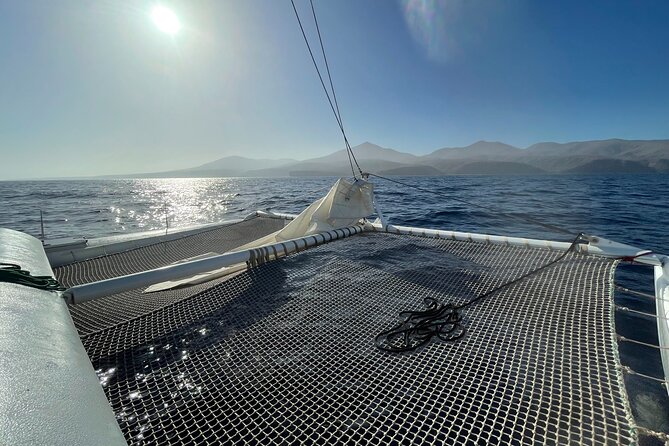
- Quiet catamaran: The emission-free boat reduces engine noise and gives the trip a calmer feel on the open sea.
- Hydrophone with conditions: It is used when whales or dolphins are nearby and vocal, not simply for the whole crossing.
- Small group size: A maximum of 12 people means more space on the 14-meter catamaran.
- Three to four hours at sea: The route begins and ends at Puerto Calero, with no separate transport between stops.
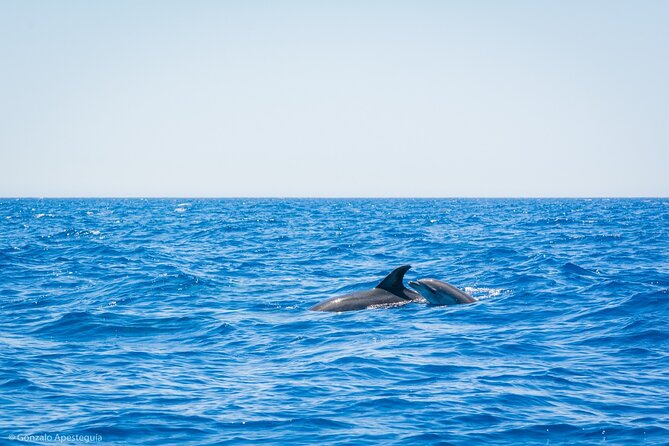
- Wildlife sightings vary: You may see dolphins, whales, or only brief signs such as a spout.
- Snacks and drinks included: Refreshments are offered during the outing, but you should bring warm layers for a cool sea breeze.
Leaving Puerto Calero on a quiet boat
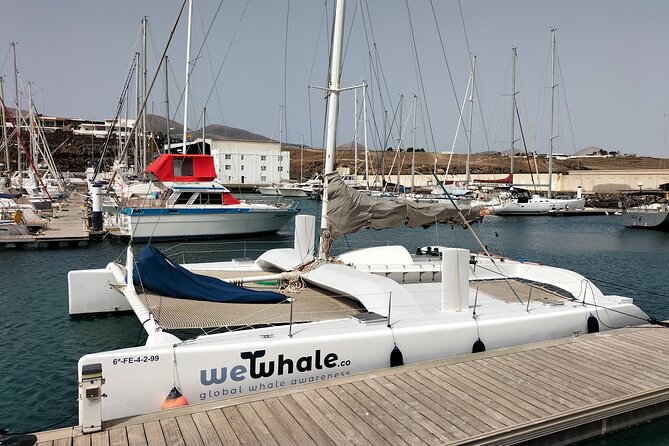
Your morning begins at WeWhale Lanzarote, at C. Pantalanes in Puerto Calero. The scheduled start is 9:00 am, so plan to arrive with enough time to find the marina meeting point without rushing. The outing lasts about four hours, though the exact length is given as approximately three to four hours.
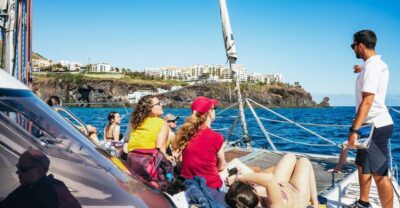
The boat is a 14-meter catamaran built for a small number of people. With only 12 passengers allowed, you are not packed shoulder to shoulder with a large excursion crowd. That matters on a wildlife trip, since you will want to shift position, scan the water, and move toward the best viewing side when something appears.
The quiet design is the heart of the experience. A standard sightseeing boat can make it harder to hear natural sounds and may alter how close animals choose to come. Here, the aim is to watch without chasing, and the crew says it will not pursue animals that keep their distance. That is good wildlife practice, even if it can make the sightings feel brief.
You should also set your expectations before leaving the marina. This is not a guaranteed dolphin show, and there is no fixed group of animals waiting at a particular location. The crew searches open water, where conditions change from day to day.
More Catamaran Whale Watching in Spain
- Costa Adeje: Whale Watching Catamaran Tour with Drinks
★ 4.7 · 3,653 reviews - Whale and Dolphin Watching Catamaran with Transfer and Buffet
★ 5.0 · 2,712 reviews - Whale watching and listening Eco-Catamaran Tour with Food Tasting
★ 5.0 · 1,447 reviews
The open-sea search for whales and dolphins
After leaving Puerto Calero, the boat heads away from shore. The main activity is scanning the water for movement, fins, blows, and groups of animals. That sounds simple, but it is a very different rhythm from a normal sightseeing cruise. You spend some time watching, then suddenly everyone focuses on one patch of sea.
A sighting may be dramatic, but it may also be quick. One recorded outing produced a view of a Bryde’s whale spout on the return journey, though the whale remained far away. That distance was intentional. The crew’s policy is to give animals space rather than approach aggressively or chase them for a closer photograph.
This is the tradeoff you should understand before paying for the trip. Responsible viewing protects the animals, but it can limit what you see. A whale surfacing far from the boat may appear as a small blow and a glimpse of its back. You might find binoculars useful, especially in this situation.
Binoculars are available on board, but you may need to ask the crew to use them. One practical improvement would be for the crew to point them out at the start. If you want a better view of a distant whale, ask early rather than waiting until the boat is already moving away.
The best outcome is seeing both dolphins and whales. That has happened on this trip, and the crew provides explanations about the animals and the viewing approach. Still, you should book this as a respectful search, not as a promise of close encounters.
What the hydrophone really adds
The hydrophone is the feature that sets this trip apart from a standard whale-watching cruise. It is an underwater microphone that can let you hear marine mammals communicating beneath the boat. In the right moment, that changes the experience from simply looking at the sea to paying attention to an unseen world below it.
There is an important condition. The hydrophone is generally lowered when the boat is near a group of vocalizing dolphins or whales. It is not used in open water when there are no animal sounds to pick up. That means you may not hear anything on a quiet day, even though the boat carries the equipment.
I think this is fair from a practical and wildlife point of view. Lowering a microphone without nearby animals would add little. But the limitation should be clear when you book, because the promotional description can make the hydrophone sound like a standard part of every departure.
If hearing the animals matters most to you, ask the crew at the start how they decide when to deploy it. You will then know that it depends on being among nearby, vocal animals, not on the clock or a fixed point in the route.
The hydrophone can also make a successful dolphin encounter feel more special. You may see animals moving around the catamaran and then hear clicks or calls below. That combination gives you more than a distant visual sighting, but it cannot be arranged on demand.
Snacks, drinks, and comfort on the water
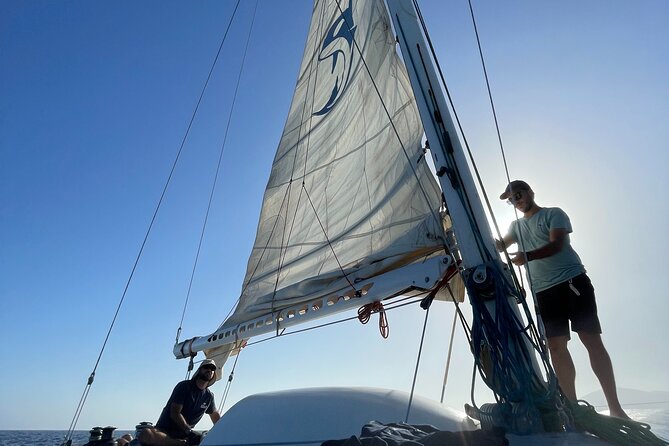
Snacks and refreshing drinks are offered during the trip. That is useful on a four-hour morning outing, especially since there is no quick stop back at the marina once the boat reaches open water. The refreshments also make the long periods of watching more comfortable.
Bring layers. Even in Lanzarote, the sea breeze can feel sharp when the boat is moving, and cloud cover can make the temperature drop. One outing became noticeably chilly when the sun disappeared behind clouds. A light jacket or fleece is a sensible addition, even if the morning begins warm on land.
You will spend much of the time outside, looking across open water. If you are sensitive to sun, pack protection for your face and neck. The supplied information confirms snacks and drinks, but it does not specify every item or provide a full meal, so do not treat this as a lunch cruise.
The small group helps with comfort. You have more room than on a large catamaran, and the boat’s size gives the outing a more personal feel. That said, the sea can still be bumpy, and no wildlife cruise can control the motion of the water.
More Whale and Dolphin Watching Tours in Spain
- Tenerife: Eco-Yacht Whale and Dolphin Watching and Swimming
★ 4.7 · 15,619 reviews - Los Cristianos Respectful No-Chase Whale and Dolphin Safari
★ 4.6 · 12,782 reviews - Costa Adeje: Whale & Dolphin Eco-Cruise with Snacks & Drinks
★ 4.6 · 5,096 reviews - Los Gigantes: Dolphin & Whale Watching Cruise with Swim Stop
★ 4.7 · 4,539 reviews
A responsible approach to wildlife
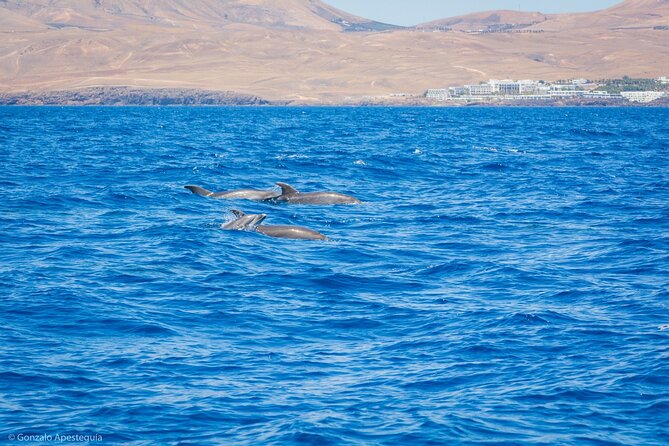
The conservation side is not just a slogan attached to the ticket. WeWhale says that part of the fare supports marine conservation work through the WeWhale Association, including the Save The Iberian Orca campaign.
That gives the price more purpose, especially if you prefer an outing linked to protection work rather than a simple sightseeing ride. It does not remove the uncertainty of the wildlife search, but it does mean your money supports a stated conservation effort even on a day with limited sightings.
The crew’s decision not to chase a whale is also important. A closer photograph may be tempting, but pressing toward an animal can cause stress and disrupt natural behavior. Keeping a respectful distance can leave you with a less dramatic view, yet it is the better standard for a wildlife trip.
I would like the conservation message and the hydrophone rules explained clearly before departure. The more you understand about the limits, the more you can appreciate a distant sighting as a responsible one rather than seeing it as a failure.
Is $114.65 a fair price?
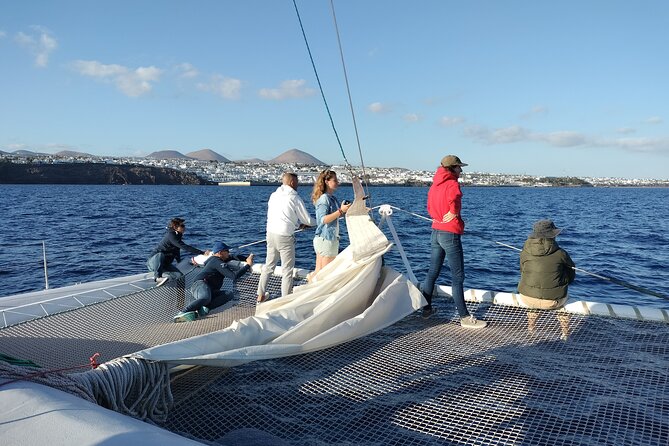
At $114.65 per person, this is not a cheap boat ride. You are paying for a small group, a specialized quiet catamaran, a crew focused on cetacean observation, refreshments, and a conservation contribution.
The value depends on what you want. If you mainly want a guaranteed close look at dolphins, this price may feel high because no sighting is promised. One outing produced a Bryde’s whale sighting but no dolphins, and the animal was too far away for a strong view without binoculars. That is a real risk.
If you care about low-noise wildlife viewing and the conservation purpose, the price becomes easier to justify. The group limit is also meaningful. You are not paying for a large, crowded cruise where dozens of people compete for the same rail.
The experience has earned a 4.7 rating from 66 reviews, with 92 percent recommending it. Those figures suggest strong satisfaction overall, but they should not change the basic rule: choose this for the method and setting, not for a guaranteed animal checklist.
Who will enjoy this four-hour outing?
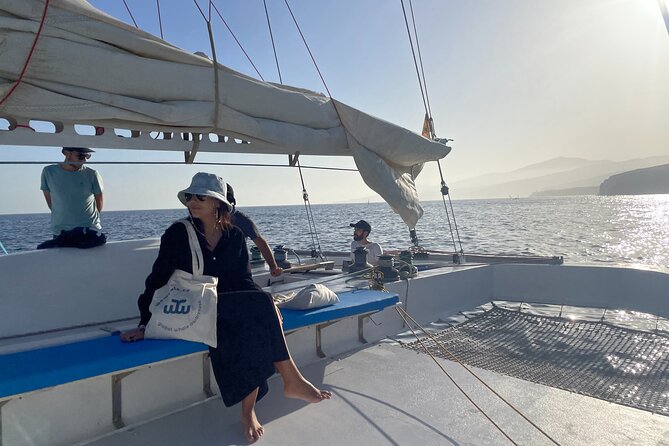
I would recommend it to people who enjoy patient wildlife watching and want a quieter, smaller boat. It suits couples, families, and anyone interested in marine conservation. The English-language offering makes the practical explanations accessible to English speakers.
It is also a good choice if you dislike large group excursions. Twelve people is still a group, but it leaves far more breathing room than a typical sightseeing boat.
You should think twice if you need constant activity. There may be long stretches of open sea with no visible animals, and the boat may need to travel a considerable distance before finding signs of life. The trip is about observation, not nonstop entertainment.
Most people can participate, and service animals are allowed. The supplied information does not give detailed access information for the catamaran, so contact WeWhale directly if you have specific mobility needs.
Booking, weather, and cancellation details
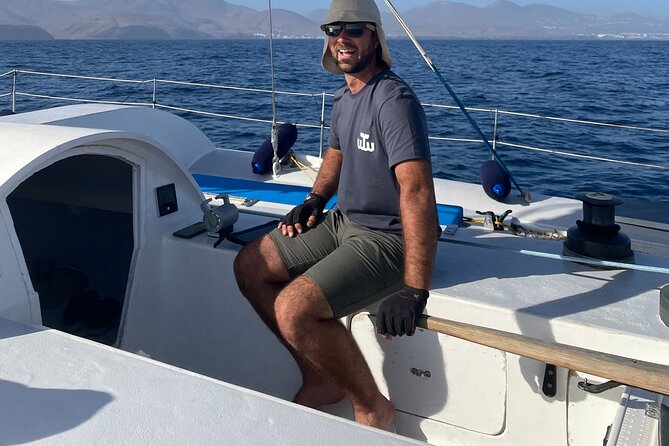
The tour is often booked about 19 days ahead, which suggests you should reserve early if your Lanzarote dates are fixed. It operates in English, includes a mobile ticket, and returns to the same Puerto Calero meeting point.
You can cancel for a full refund up to 24 hours before the 9:00 am start time. Changes or cancellations made less than 24 hours before departure are not refunded. If poor weather forces the operator to cancel, you will be offered another date or a full refund.
Weather matters for more than comfort. Wind, cloud, and sea conditions affect how pleasant it is to stand outside and how easy it is to spot animals. The operator makes the final call when conditions are unsuitable.
Should you book the silent catamaran?
Book it if you value a small, quiet boat, responsible viewing, and a real conservation link. The chance to hear dolphins or whales through a hydrophone is unusual, and seeing both whales and dolphins would make the four hours memorable.
Do not book it expecting a guaranteed close encounter or a hydrophone demonstration on every trip. You may see only a distant spout, and you may not see dolphins at all. Bring warm layers, ask about the binoculars and hydrophone early, and judge the $114.65 price against the quality of the approach rather than the number of animals seen.
For a patient observer, this is a thoughtful way to spend a morning off Lanzarote’s coast. For someone who wants certainty, speed, and close-up views, a different activity may offer better value.
FAQ
Where does the whale and dolphin tour start?
The tour starts at WeWhale Lanzarote, C. Pantalanes, 35571 Puerto Calero, Las Palmas, Spain.
What time does the experience begin?
The scheduled start time is 9:00 am.
How long does the catamaran trip last?
The outing lasts approximately three to four hours and returns to Puerto Calero.
How many people can join the tour?
The catamaran accepts a maximum of 12 people.
Is the hydrophone used on every departure?
No. The hydrophone is generally used when the boat is near a group of vocalizing dolphins or whales. It is not necessarily deployed during open-water searching.
What happens if the weather is poor?
If the operator cancels because of poor weather, you can choose another date or receive a full refund. For your own cancellation, you must cancel at least 24 hours before the start time for a full refund.
More Viewing Decks in Spain
- Whale & Dolphin Observation on Electric Sailing Boat in Denia
★ 4.5 · 10 reviews - Observation of Dolphins and Whales with Marine Biologist in Arrábida
★ 5.0 · 224 reviews - Tadoussac/Charlevoix: Whale Watching Tour & Bear Observation
★ 3.9 · 123 reviews - Observation of whales and dolphins in island Pico
★ 4.7 · 76 reviews
New whale trips around Spain
- Tenerife Whale Watching and Snorkeling Yacht Trip★ 4.5 · 162 reviews
- Whale & Dolphin Watching With Mustcat Virgin Coast Trip On a Large Catamaran★ 4.0 · 3 reviews
- Whale watching and snorkelling in the whale sanctuary★ 5.0 · 14 reviews
- Whales and Dolphins excursion on a Luxury Yacht in Canary Islands★ 5.0 · 93 reviews
- Whale and Dolphin Watching EcoAdventure in Tenerife★ 5.0 · 78 reviews
- Whale & Dolphin Watching Boat Trip in Tenerife On a Sailing Boat (3 Hr)★ 3.5 · 10 reviews
- Whale & Dolphin Watching in Tenerife (Puerto Colon) On a Large Catamaran★ 4.0 · 12 reviews
- Whale Watching and Marine Science Tour★ 5.0 · 111 reviews
Catamaran Whale Watching, compared.
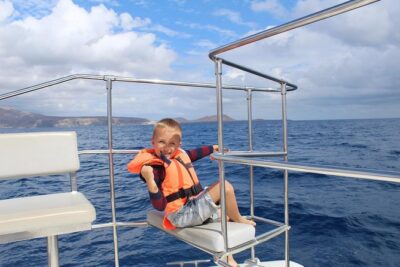
Whale and Dolphin Watching Catamaran with Transfer and Buffet
Read our review →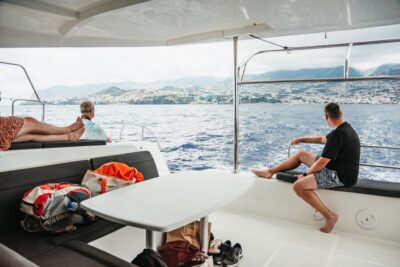
Funchal Bay: Dolphin & Whale Watch Luxury Catamaran Cruise
Read our review →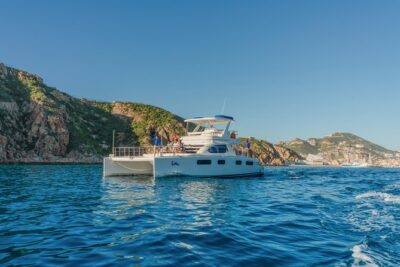
Luxury Catamaran Whale Watching Cabo San Lucas
Read our review →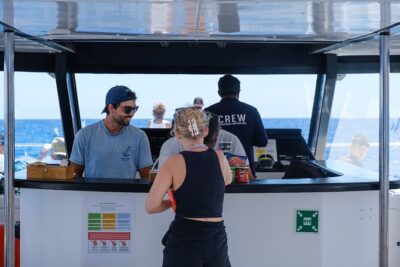
Madeira Dolphin and Whale Watching on a Ecological Catamaran
Read our review →