Review · TOURS
Whale watching tour SEASONAL
Boa Vista’s main whale-watching draw is the seasonal return of humpback whales, which come to these waters to breed from about mid-February through late May. The small boat puts you close to the action, and a marine biologist rides along to help protect both whales and people. I like the limited six-person group and the clear effort to follow European whale-watching rules. I also like that fresh water and non-alcoholic drinks are included.
The catch is simple: wild whales set the schedule, not the tour operator. One booking saw at least four whales, while another person saw one whale but missed it entirely. The tour is best for adults and children aged 10 or older who can accept an uncertain result.
Key points at a glance
- Humpback season runs from mid-February to late May: This is the main window for seeing breeding whales near Boa Vista.
- Six people maximum: A small group gives you a better chance of seeing from different sides of the boat.
- A marine biologist comes aboard: You get guidance on animal behavior, distance, and safe viewing.
- Cape Verde has more than humpbacks: The islands are home to, or crossed by, 24 species of whales and dolphins.
- Transfers cost extra: Pickup from central Sal Rei starts at €4 one way, while the Riu Touareg transfer costs €50 round trip.
- Sightings are not guaranteed: The sea can offer four whales, one distant whale, or no useful sighting at all.
Meeting Boa Vista’s seasonal humpbacks
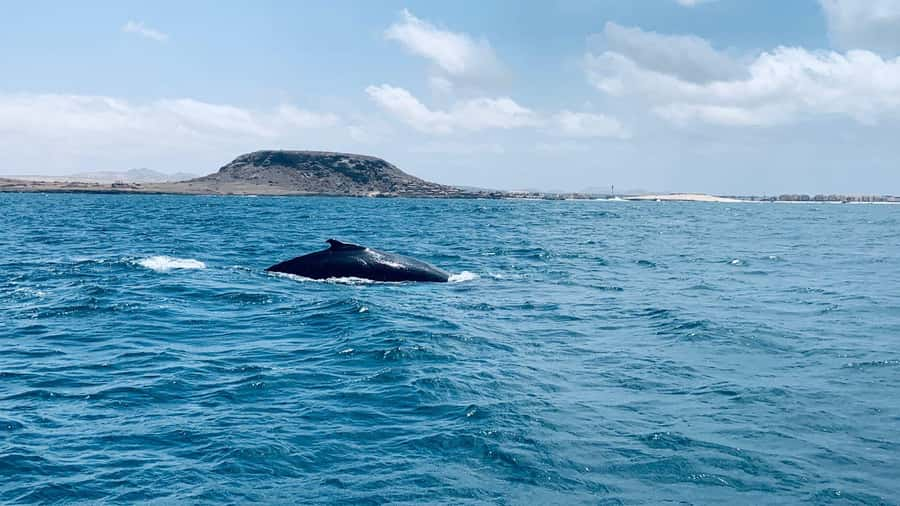
This is not a year-round whale trip. The useful window is mid-February to late May, when humpback whales visit Boa Vista for breeding. That season gives the outing a clear purpose, but it also makes timing important. If whale watching is high on your Cape Verde plans, book within this period rather than treating it as a casual all-season option.
Cape Verde sits along a route used by 24 species of whales and dolphins. That means the trip is not limited to one target animal, even though humpbacks are the star. You might see a different whale or dolphin species, but the experience is built around the possibility of finding humpbacks.
The word possibility matters. You are watching wild animals in open water. They may surface close to the boat, appear only briefly, or remain out of sight. One May outing produced at least four whale sightings, while a March booking resulted in one whale that the participant missed. Another March trip had three sightings. Those different results tell you exactly how to judge this outing: it offers a real chance, not a guaranteed show.
More whale watching around the world worth comparing
- Tenerife: Eco-Yacht Whale and Dolphin Watching and Swimming
★ 4.7 · 15,619 reviews - Los Cristianos Respectful No-Chase Whale and Dolphin Safari
★ 4.6 · 12,782 reviews - Reykjavík: Whale Watching and Marine Life Cruise
★ 4.6 · 9,838 reviews
What the small boat changes
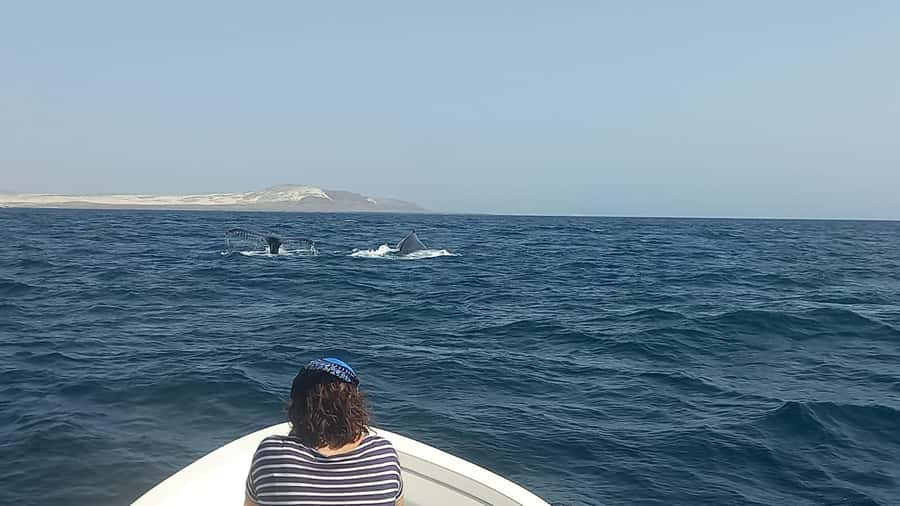
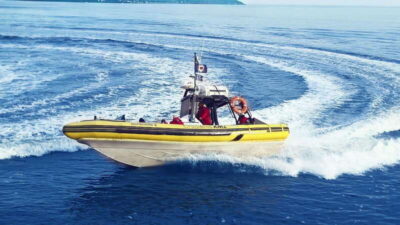
The group limit is six people. That is one of the strongest features of the trip because it keeps the boat from feeling crowded and gives you room to look around when a whale surfaces.
A small group also makes each sighting feel more personal. One person described the boat as small enough to give a strong sense of the whales’ size when they appeared. That is a useful point. Humpbacks are enormous animals, and seeing one from a compact boat can make the scale easier to understand than watching from a large vessel packed with people.
The tradeoff is that a small boat may feel more exposed to movement on the water. The supplied details do not specify the boat design, ride length, or seating arrangement, so you should not assume a smooth or spacious crossing. If you are prone to seasickness, ask Riamar Center for current conditions and practical advice before you go.
The limited group suits you if you prefer quiet observation and quick access to the view. It is less suitable if you want the certainty of a large vessel with more room to move, though no large boat can guarantee a whale sighting either.
A marine biologist on board
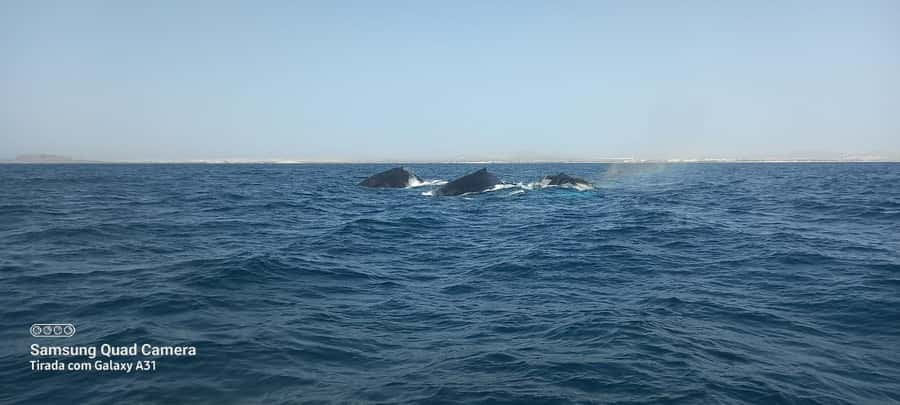
A marine biologist accompanies every tour. This is important for more than adding facts to the trip. The guide helps keep the encounter safe and helps the boat follow the rules intended to reduce disturbance to whales and dolphins.
The operator follows European whale and dolphin-watching laws. In practical terms, that means the animals are treated as wild creatures rather than performers. The boat should not chase them simply to produce a better photograph, and your viewing time depends on the animals’ movement.
I like that the conservation message is built into the outing: you are a visitor in the sea, and the whales are not there for your convenience. The marine biologist also gives the trip a stronger educational side, even though the available information does not name the guide or list a detailed talk.
You should expect instructions about staying safe, watching the water, and respecting the animals. Listen closely. On a small boat, a quick movement or sudden sighting can catch everyone off guard.
How the outing may unfold
The exact departure time depends on availability, so check the schedule when booking. Pickup can be arranged from several hotel areas, but the transfer is not included in the tour price.
If you are in central Sal Rei, the charge is €4 one way. Pickup from Riu Karamboa, Riu Palace, Decameron, and Bravo is €10 one way. For the Riu Touareg, the stated price is €50 for both ways. Confirm the currency and current transfer cost before paying, especially if you are comparing this trip with hotel-based excursions.
Once on board, the main activity is searching the water for signs of whales and dolphins. The supplied information does not give a fixed route, named stops, or a guaranteed time at sea. That is normal for an animal-watching trip, but it means you should not expect a sightseeing itinerary with several scheduled landmarks.
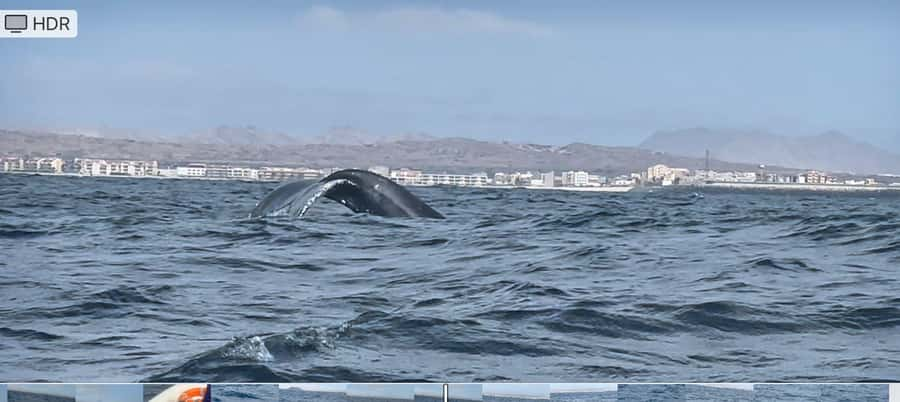
The best part of the route is the moment when the search ends and the animal appears. A humpback may surface, show part of its body, or disappear before you have your camera ready. Keep watching rather than staring only at your screen. One person missed the only whale seen, which is a good reminder that photographs should come second.
Fresh water and non-alcoholic drinks are included. Alcohol is not allowed, and neither are drugs or explosive substances. Bring a towel, beachwear, a camera, and a head covering or kippah. The head covering is specifically listed among the required items, so pack one even if you would not normally bring it on a boat trip.
Same sea, a different boat:
- From Funchal: Ecological Catamaran Dolphin Whale Watching
★ 4.5 · 8,204 reviews - Juneau Wildlife Whale Watching
★ 5.0 · 7,379 reviews - Juneau Wildlife Whale Watching & Mendenhall Glacier
★ 5.0 · 6,236 reviews - Funchal: Dolphin and Whale Watching Catamaran Cruise
★ 4.5 · 5,697 reviews
The real value of €65 or about $76
The supplied prices do not match perfectly. The headline price is $76 per person, while the included section lists the whale-watching tour at €65 per person. Treat that as a point to verify before booking rather than assuming one figure is final.
At either price, the value depends on what you want from the outing. You are paying for a small group, a marine biologist, an eco-conscious approach, onboard water and soft drinks, and the chance to see a large wild animal in its natural setting. You are not paying for a guaranteed number of whales.
The small group helps justify the cost. Six people is very different from a crowded boat where everyone competes for the same view. The onboard specialist also adds value by placing the encounter in a safety and conservation framework.
The value is weaker if your main goal is a guaranteed photograph. Even a well-run tour cannot control the whales, weather, sea conditions, or the timing of a surface. The different sightings recorded in March and May show how wide the outcome can be.
Transport can also change the total. A person staying in central Sal Rei pays only a small one-way fee, while the Riu Touareg transfer is much more expensive. Add that to the ticket price when comparing the tour with other activities.
Why conservation rules matter here
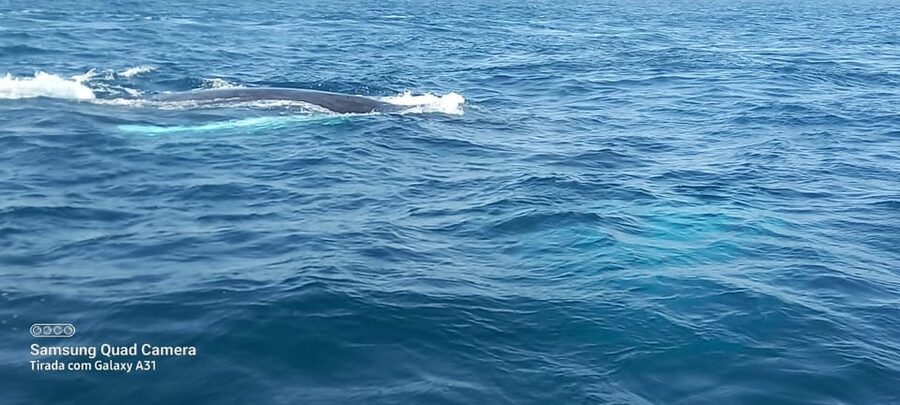
Whale watching can be thrilling, but careless boats can interrupt feeding, breeding, and rest. Following European rules gives the operator a clear standard for keeping a respectful distance and limiting pressure on the animals.
That approach may mean you do not get as close as you hoped. I consider that a fair trade. A close photograph is not worth forcing a whale to change direction or separating it from another animal.
Cape Verde’s position along a route used by 24 whale and dolphin species makes responsible behavior especially important. You are not visiting an aquarium with a fixed display. You are entering a marine area used by many species at different times of year.
The marine biologist’s presence supports this approach. You can ask questions about what you see, but the central lesson is restraint. Watch carefully, keep your camera ready, and let the animals decide the encounter.
Who should book this Boa Vista trip
I would recommend this tour to people who care more about the quality of a wild encounter than a guaranteed checklist. It suits adults, couples, photographers, and older children who can stay alert and patient on a small boat.
It is also a good fit if you prefer a group of six rather than a large excursion. The small setting can make a brief sighting feel more immediate, and you will not need to compete with dozens of people for every view.
Children under 10 are not permitted. Families with older children should explain beforehand that the tour may produce several whales, one whale, or an animal too quick to photograph. That honest expectation will make the trip easier to enjoy.
You should think twice if you need a fixed sightseeing program or a guaranteed result. This is a search-and-watch activity. The sea may reward you quickly, or it may test your patience.
Practical ways to improve your chances
Choose a date within the stated humpback season, from mid-February to late May. The operator also describes the activity as valid for two months, so check the live calendar carefully because the seasonal dates and booking-period wording do not line up perfectly.
Keep your camera ready before the boat finds anything. A whale can appear and vanish in seconds, and looking down to adjust settings may cost you the sighting.
Bring every item requested: a head covering or kippah, towel, camera, and beachwear. Pack only permitted refreshments if you need something beyond the included fresh water and non-alcoholic drinks.
Do not plan the tour around alcohol. It is specifically prohibited, along with drugs and explosive substances.
If your hotel is outside the listed pickup areas, ask about transport before booking. The published pickup choices cover central Sal Rei, several Riu properties, Decameron, Bravo, and Riu Touareg, but no other locations are confirmed.
You can cancel up to 24 hours before the outing for a full refund, and the reserve-now-pay-later option lets you hold a place without paying immediately. Those policies help when your plans are still moving, but they do not reduce the natural uncertainty of the whale search.
Should you book it?
Book this Boa Vista whale-watching trip if you are visiting during humpback season, value a six-person group, and want an encounter guided by a marine biologist and conservation rules. The strongest results can be memorable, with multiple sightings and a clear sense of the whales’ size.
Do not book it expecting a guaranteed whale, a fixed route, or a perfect photograph. The mixed outcomes are part of the deal with wildlife. Confirm whether the current price is €65 or about $76, add your hotel transfer fee, and choose it only if you can enjoy the search as much as the sighting.
FAQ
When is whale watching available in Boa Vista?
The humpback whale-watching season runs from mid-February to late May.
What whales are you most likely to see?
The tour focuses on humpback whales, which visit Boa Vista for breeding. Cape Verde is also used by 24 species of whales and dolphins, so other species may be seen.
Is a whale sighting guaranteed?
No. Wild animal sightings are not guaranteed. Results can vary from several whales to one whale that appears too quickly to see clearly.
How many people are in each group?
The group is limited to six participants.
Is a marine biologist on the boat?
Yes. A marine biologist is always on board to support the safety of people and animals.
What is included in the tour?
The whale-watching tour includes non-alcoholic drinks and fresh water. The listed tour price is €65 per person, while another stated price is $76, so confirm the current amount before booking.
Are hotel transfers included?
No. Transport is available for an additional charge.
How much is pickup from central Sal Rei?
Pickup from central Sal Rei costs €4 one way.
Can children join the tour?
Children under 10 are not permitted. The minimum stated age is 10.
What should I bring?
Bring a head covering or kippah, towel, camera, and beachwear.
Can I cancel the booking?
Yes. You can cancel up to 24 hours in advance for a full refund.
What language is the tour offered in?
The live tour guide speaks English.
New whale trips around the world
- Wismar: Electric Boat Tour past Whale Island with Poel Stop★ 4.3 · 91 reviews
- Newport Beach: Year-Round Whale Watching Cruise★ 4.2 · 151 reviews
- Juneau: Mendenhall Glacier and Whale Watching Tour★ 4.6 · 98 reviews
- Wilsons Promontory: Whale Spotting Cruise with Lunch★ 4.9 · 20 reviews
- Madeira : Whales and Dolphins wooden boat excursion★ 4.1 · 247 reviews
- Whale Watching Tour with Transfers★ 3.6 · 4 reviews
- West Oahu: Eco-Friendly Whale Watching Cruise★ 4.5 · 40 reviews
- From Punta Canta: Whale Watching Cruise with Cayo Levantado★ 3.9 · 7 reviews
Tours, compared.
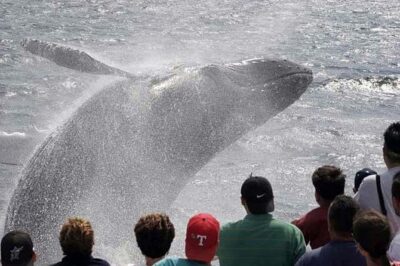

Whale Watching & Islet Boat Tour w/ Marine Biologist
Read our review →
Tadoussac/Charlevoix: Whale Watching Zodiac Tour
Read our review →